Knee Pain from Padel
Akeso Physio Clinics – 15th April 2026, Jakarta, Indonesia
If your knees have started complaining every time you step on a padel court, you are not alone. We are seeing more padel-related knee injuries in our clinics than ever before, driven by Jakarta's explosion in the sport over the last few years. The good news: it is highly treatable, and you do not have to stop playing permanently.
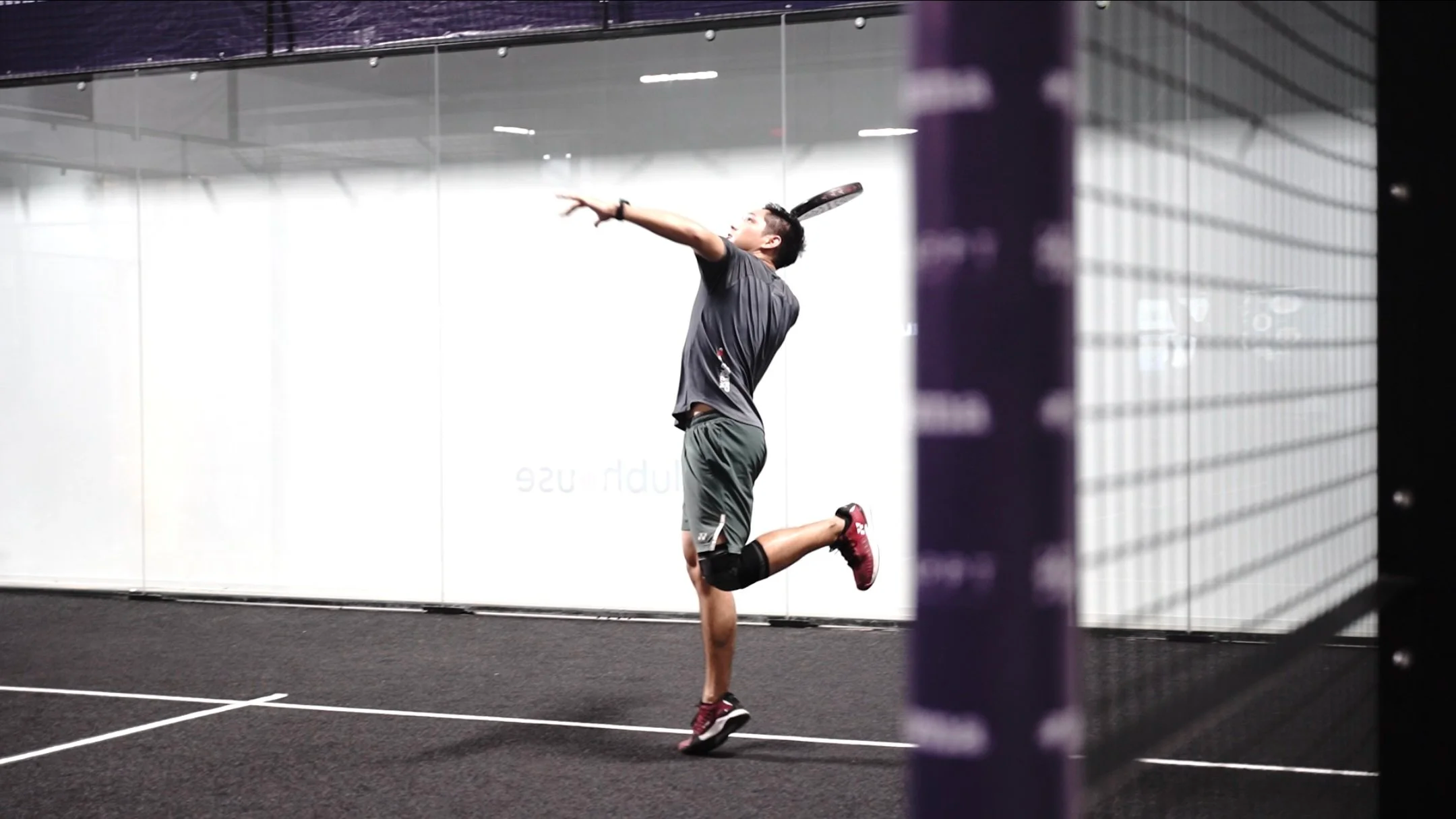
Padel's explosive lateral movement, repeated deep knee bends, and rapid direction changes place enormous demand on the patellar tendon — the thick band connecting your kneecap to your shin. Play several times a week without adequate recovery, and that tendon accumulates stress faster than it can repair. The result is patellar tendinopathy: a spectrum of tendon irritation and degeneration that shows up as pain at the front of the knee, a grinding or clicking sensation, and that telltale stiffness when you bend the knee after sitting still. It is not an ACL problem. It is not a joint problem. It is a tendon problem — and it is highly treatable.
How we treat it
Phase 1: Get out of pain
Before anything else, we need to calm the tendon down and begin the healing process. Our manual therapy is precise and targeted: our therapists locate the exact structures involved and release them with the anatomical accuracy that comes from years of rigorous training. You will feel the difference.
Soft tissue therapy – targeted release of the quadriceps, patellar tendon insertion, and surrounding fascia
Joint mobilisation – restoring normal movement at the knee and hip to reduce compensatory loading
Ultrasound therapy – promoting tissue healing deep within the tendon
Load management advice – what to keep doing, what to modify, what to stop
Phase 2: Rebuild
Pain relief is the beginning, not the destination. We follow a structured movement progression from our Academy framework, that rebuilds the tendon's capacity from the ground up.
| Step | What it means | What it looks like |
|---|---|---|
| Awareness & Activation | Learn to feel and control the right muscles before loading them | Identifying the quad, feeling the kneecap move, deliberately firing the muscle |
| Dissociation & articulation | Isolate movement to the right joint, remove compensation | Holding the shin still, moving the femur independently |
| Congruent movement | Smooth, controlled, pain-free range of motion | Fluid knee movement without guarding or hitching |
| Load Progression | Introduce resistance gradually – isometric first, then dynamic | Holds, pulses, eccentric loading, building tendon capacity step by step |
| Functional Complexity | Replicate the real demands of padel | Single-leg loading, rotational patterns, hitting off a wall, lateral cuts |
Phase 3: Return to play and ongoing management
When you return to padel, the tendon will flare up. That is not failure — it is normal. The goal in this phase is not zero symptoms; it is manageable symptoms that trend toward zero over time. We track your threshold: first you feel it after 90 minutes, then two hours, then only the next day, then not at all.
During this phase, periodic manual therapy sessions keep micro-tears and accumulated tightness from tipping back into the painful cycle. Return to sport is a phase in itself, not a finish line.
Meet Eri
Eri is a 40-year-old businessman who plays padel three to four times a week. He had been dealing with knee pain for almost a year – pain at the front of the knee when playing, a grinding sensation during movement, and stiffness every time he stepped out of the car. He tried resting. It improved. He went back to playing. It came back.
When he came to Akeso, his Clinic Director assessed the full picture – not just the knee, but his loading patterns, movement mechanics, and training history. The diagnosis was patellar tendinopathy. A clear three-phase plan followed.
★★★★★
“I had tried other places and it always came back as soon as I started playing properly again. What was different here was that they explained exactly what was happening and had a plan for every stage. The manual therapy was on another level – I’ve had physio before, but nothing like this. I’m back playing three times a week and I come in for maintenance sessions because I can feel the difference.”
Does this sound like your knee? Book a consultation with one of our Clinic Directors — a full assessment, a clear diagnosis, and a Care Plan. No referral needed. Most major insurance accepted.